

‘Avatar: Fire and Ash’ is a triumph of craft, but runs out of story
It might be time for James Cameron to unplug from Pandora

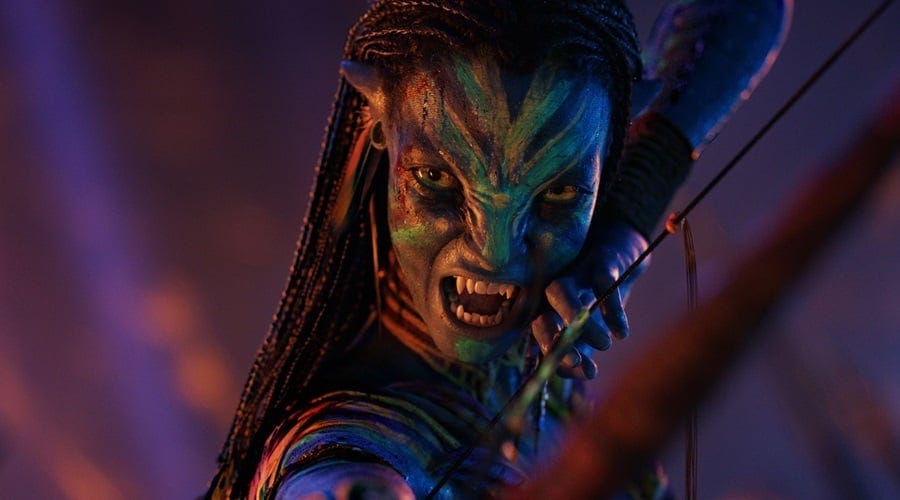
I did not go into Avatar: Fire and Ash hoping to dislike it. The franchise has its haters, but I’ve never been one. I still think James Cameron’s 2009 science fiction epic is a thrilling visual masterpiece, and Avatar: The Way of Water doubles down on everything that made its predecessor so impressive. I’ve had a great time wandering Pandora at Walt Disney World, and I even sat down recently to watch the two-part Disney+ documentary about the making of the films. I went into Fire and Ash expecting to be wowed again.
And at first, I was. The film opens high above Pandora as two Na’vi horse around on their banshees, and for a few moments, it’s impossible not to be swept up. No matter how many movies rely on CGI or motion capture, and no matter how hard studios keep trying to push 3D, no one does it better than Cameron. His environments feel real, and his creatures are tactile. The characters pop off the screen with depth and weight. An Avatar movie looks like no other blockbuster; it genuinely feels like visiting another world.
Then, the characters start talking.
This isn’t new. Cameron has never been known for his dialogue, and the “bro”-heavy banter among the younger Na’vi started back in The Way of Water. In that film, however, the clunky lines were often in service of a story that, while familiar, found new places to go and new ways to challenge its characters. Fire and Ash, by contrast, spends much of its three-and-a-half-hour runtime spinning its wheels or replaying beats from the earlier films. It still looks incredible, but there’s an unmistakable sense that Cameron is running out of narrative.
The film picks up some time after The Way of Water and finds the Sully family still living among the Metkayina. Jake (Sam Worthington) remains a father struggling to connect with his children, particularly Lo’ak (Britain Dalton), whom he still partially blames for the death of his other son. Neytiri (Zoë Saldaña) continues to harbor a deep hatred of humans, making it difficult for her to accept Spider (Jack Champion) as part of the family. Kiri (Sigourney Weaver) maintains her mysterious bond with Eywa, though a kind of spiritual “block” prevents her from fully accessing the spirit world. Meanwhile, Colonel Quaritch (Stephen Lang), resurrected as a Na’vi avatar, continues his obsessive pursuit of Jake while attempting to reconnect with Spider.
When circumstances force the Sullys to flee the Metkayina in an effort to protect Spider, they cross paths with the Ash People, a fire-dwelling Na’vi clan that inhabits a scorched, volcanic region of Pandora. Led by the ferocious Varang (Oona Chaplin), the Ash People are defined by brutal rituals and a belief that Eywa abandoned them when fire devastated their land. Unsurprisingly, Varang finds a kindred spirit in Quaritch, who is fascinated by her warrior culture and eager to supply her with human firepower.
As always, the Avatar films are at their strongest when they simply explore Pandora. The most compelling stretch of The Way of Water played almost like a nature documentary, and the same is true here. Watching Na’vi soar through the sky or bond with massive creatures remains astonishing, especially considering none of it exists. The fire world, glimpsed in brief stretches, is particularly striking: gray with ash, ominous, and home to unsettling customs that immediately set it apart from the lush regions we’ve seen before.
That’s why it’s so disappointing that the Ash People never fully emerge as the film’s central threat. Early on, Varang and her clan seem dangerous enough to potentially force Jake and Quaritch into an uneasy alliance. There’s even an intriguing, oddly charged, weirdly sexual relationship that develops between Varang and Quaritch. But once the Marines show up with guns, the Ash People are reduced to little more than foot soldiers. The film never fully explores their resentment toward Eywa or their place within Na’vi society, flattening what could have been its most compelling new idea.
Other storylines are intermittently effective. Kiri’s struggle to understand her connection to Eywa and her origins as a clone of Weaver’s character from the first film is given a vaguely techno-spiritual explanation that functions more as plot scaffolding than genuine insight. Still, Weaver is so strong in the role that the emotional weight of Kiri yearning for something just out of reach lands beautifully. This thread also leads to new developments for Spider that carry potentially enormous consequences for Pandora. For a moment, the film seems interested in exploring what compromises Jake and Neytiri might make to protect their world, but these questions are ultimately sidelined in favor of setting up yet another large-scale battle.
To Cameron’s credit, Fire and Ash is actually about something. Unlike many modern franchise entries, it’s engaged with ideas, even if they’re delivered with a sledgehammer. Environmentalism remains a central concern, as does Cameron’s late-career fascination with family. The family theme is the most successful; there’s a moment where Jake and Neytiri must make a painful decision involving Spider, and even though the outcome is obvious, the actors sell the emotional conflict. Cameron’s environmental message, however, feels increasingly redundant. Everything said here was articulated more clearly in the previous films, and the franchise’s anti-military stance rings hollow when the solution once again involves rallying peaceful clans and animals to kill invading humans.
These contradictions have always existed in Cameron’s work. Terminator 2 is a movie about learning the value of life, yet it’s also a relentlessly action spectacle. The difference is that Cameron has historically offset these tensions by placing his characters in new conflicts and staging action sequences that felt genuinely innovative. That’s why the film’s final third is such a letdown. It replays the same beats from The Way of Water: another rally to war, another last-minute arrival of reinforcements, another fight between Jake and Quaritch aboard a sinking vessel, another instance of Jake telling his kids to stay put only for them to rush in and save the day. There’s even another whale hunt anchoring the climax. Everything is bigger, louder and longer, but it’s also deeply familiar.
Many movies suffer from weak third acts. Few have third acts that last as long as an entire feature film. As Fire and Ash drags toward its 3.5-hour runtime, the recycled dialogue and blunt speeches become harder to excuse. The visuals remain impressive, but as the climax approached, I found myself thinking, “Oh no, not the whales again.”
None of this negates Cameron’s extraordinary craftsmanship. His command of large-scale action remains unparalleled, and his use of 3D is still the gold standard. There were moments in my screening where it genuinely looked like characters were standing in the theater itself. While I remain unconvinced by high frame rate, it’s deployed here more effectively than anywhere else, especially in fully CGI sequences where the heightened realism can be startling.
Cameron has also been adamant that no AI is used in creating the Na’vi. Instead, the performances are captured through advanced motion-capture and enhanced with digital “makeup1.” Every expression belongs to the actors, and it shows. Worthington and Saldaña continue to deepen their characters, Chaplin is electrifying as Varang, and Weaver once again brings unexpected nuance to Kiri. Lang, however, feels adrift when asked to do anything beyond menace; a moment where he declares “that’s not cool” drew laughter in my theater for all the wrong reasons.
Avatar: Fire and Ash is still a technical marvel, but it’s the first film in the franchise that left me feeling like I’d seen very little that was truly new. Its reliance on recycled conflicts and familiar set pieces becomes exhausting over its considerable length. I want Cameron to keep pushing filmmaking forward and exploring new technology. But after three films, Pandora is starting to feel less like a world of infinite possibility and more like a place he’s reluctant to leave. Maybe it’s time for him to unplug and build something new.
The Disney+ documentary Fire and Water: The Making of the Avatar offers a fascinating look at just how much work goes into bringing Pandora to life.