

REVIEW: Disclosure Day
A messy but effective reminder that no one does this better than Spielberg.

What do we think of when we think of a Steven Spielberg blockbuster? Is it the fast-paced thrills of Raiders of the Lost Ark, the terror of Jaws or the wonder of E.T.? Is it a dark genre twist on political ethics like Minority Report or a CGI spectacle like Jurassic Park or Ready Player One?
There isn’t even a clear-cut answer as to what “a Steven Spielberg alien film” means. Close Encounters of the Third Kind is a domestic drama that becomes a religious experience. E.T. is a coming of age story with a father figure from the stars. With War of the Worlds, he replaced “they’re here and we have nothing to fear” with post-9/11 anxiety1.
His latest, Disclosure Day, often feels like an attempt to merge the director’s blockbuster sensibilities, combining the conspiracy thrills of his later works with the emotion of his earlier classics. While it can’t quite overcome an overstuffed script, in its best moments, it’s a reminder that there are still few who deliver a mix of thrills and transcendence like Steven Spielberg.
The film follows two storylines. In one, Daniel Kellner (Josh O’ Connor) tries to remain one step ahead of a shadowy tech corporation (is there any other kind?) after he steals evidence that reveals 70 years of coverups regarding extraterrestrials. Kellner tells his girlfriend, Jane (Eve Hewson), that he intends to provide “full disclosure,” revealing the secret to the entire world with the help of a group of conspirators led by Hugo (Colman Domingo). On their trail is Noah (Colin Firth), the head of the corporation that has been keeping much of this secret even from the government.
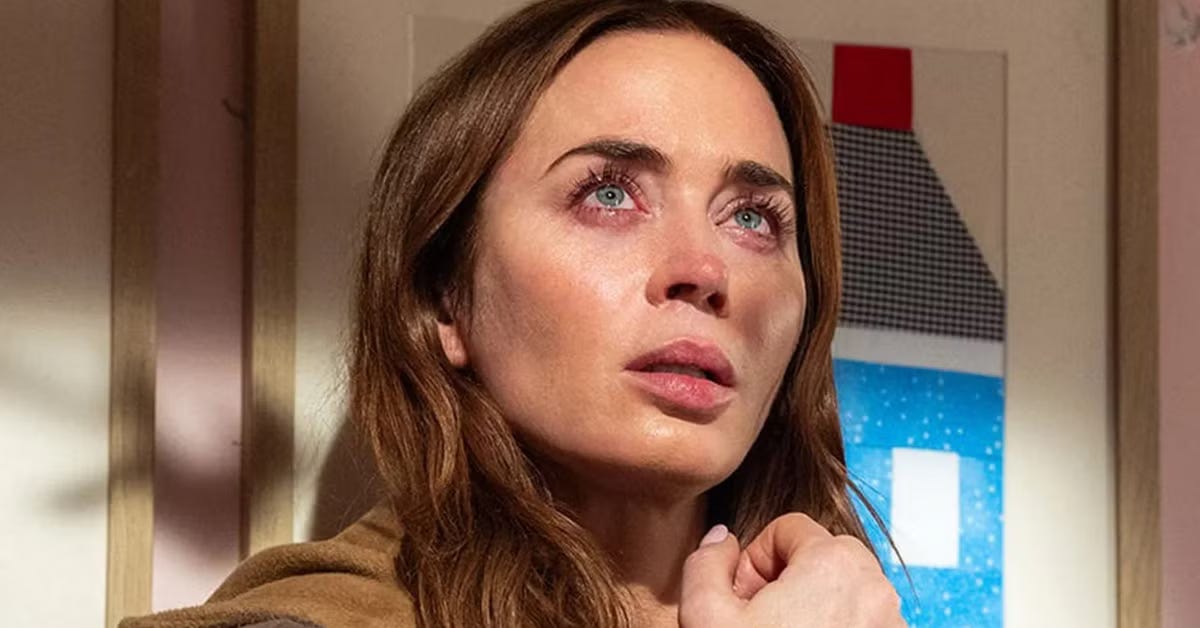
The story also follows TV meteorologist Margaret Fairchild (Emily Blunt), whose normal day begins to get very weird when she starts speaking in strange languages and showcases an out-the-blue knack for feeling people’s feelings. When an on-air meltdown prompts a visit from folks claiming to be the FBI, Margaret and her boyfriend (Wyatt Russell) hit the road, with a premonition telling her to find Kellner.
Spielberg probably couldn’t have foreseen that he would release the film during a year when the government is actually disclosing (extremely vague) UFO/UAP reports, but David Koepp’s script – from a story idea by the director – taps into the tension and anxiety we’ve been living in for a decade. At the edges of the film, the world is on the brink of World War III, and while the film doesn’t delve deeply into the specifics – something about North Korea and Russia – its depiction of people making runs on gas stations and convenience stores is reminiscent of the COVID dashes for toilet paper and the current panic over rising prices and constant international turmoil. It taps into Spielberg’s late-career skepticism about America and its institutions and the panic that keeps us divided and distracted.
The film’s first half is largely all chase. Spielberg’s camera is always moving, and he favors longer shots and extended tracking instead of the quick cuts and bad geography that fill so many modern blockbusters. There’s an exciting car chase, and an encounter with a truck and a train that ratchets up the suspense. The quick escapes – along with a mysterious device that allows the villains to “be” in two places at once – escalate the tension, and Spielberg’s sense of pacing is still muscular; there’s a throughline from the truck chase in Raiders to several of Minority Report’s best moments that leads to this. It’s almost as after delivering what could have been a career mic drop with The Fabelmans, the director wants to remind audiences he can still direct the hell out of a set piece.
In places, Disclosure Day often feels like a companion piece to Close Encounters of the Third Kind. Margaret feels drawn toward places and people just like Roy Neary did – although, to be clear, a news station in Kansas City is not nearly as iconic as Devil’s Tower. There are shadowy operatives trying to decide who gets access to the truth – the government in the 1977 film, a tech corporation here. There are scenes of wide-eyed children encountering beings beyond their comprehension, and the constant question of whether we should fear these mysteries or pursue them. And just as the climax of Close Encounters found a way to marry music and computers – a theme that Spielberg realized decades later echoed the division between his parents – Disclosure Day has its own revelations about the importance of empaths and engineers in exploring the mysteries of our world.
Early on, Jane, who was formerly a nun, warns that Josh can not reveal his knowledge to the world because it would cause chaos. “People have been raised to believe in a supreme being,” she says. “What happens when they learn supreme beings actually exist?” But Spielberg retains the humanism that has long fueled his career; he believes people can handle a world that’s bigger and more mysterious than they’ve been led to believe, and that world-shaking revelations wouldn’t necessarily be world-ending ones. His cynicism is saved for those who want to control what we know and put parameters around what we can engage with and how. People, the film believes, must have the freedom to explore truths that could unravel their assumptions and expand their capacity for empathy and understanding. It’s all in the context of an alien thriller, but the themes are deeply relevant to our everyday existence.
The story takes several big swings, exploring concepts of empathy and trauma, with a final stretch that finds Spielberg examining the power of nostalgia – which he has oft been criticized for wielding like a cudgel – to better understand ourselves and our world. These are the film’s most blatantly emotional moments, and if the action-packed first half proves Spielberg maintains his knack for set pieces, the final is a reminder that the combination of “Spielberg face” and a John Williams score still creates an almost chemical reaction. It also helps to have strong actors at your disposal. Blunt, who must balance excitement over her new abilities with fear over being out of control, delivers one of her very best performances. And Wake Up Dead Man already proved that O’ Connor can be dynamite as characters searching for truth that goes deeper than mere facts.
Koepp’s script struggles to hold together all these ideas – at times, it feels like the inverse problem of prestige TV, trying to cram 10 hours of story into a 2.5-hour package. Hewson and Russell’s characters largely disappear for the final stretch and heady concepts, like how the church might approach the revelation of extraterrestrials, are waved away with a simple phone call2. It feels like there’s an entire half hour detailing the history between Firth and Domingo’s characters that has been reduced to the latter providing breathless exposition – although if you need to have someone deliver exposition, you could do a lot worse than Colman Domingo. The film’s inclusion of Jedi mind tricks and crop circles is, at times, underbaked, and its reliance on glowing magic sticks sometimes threatens to topple into absurdity. I couldn’t help but want more of the thematic explorations and a bit less of the more genre-centric concepts. But a film that’s too full of ideas that aren’t fully explored is preferable to the empty noise that fills most our summer events.
And yet, when Spielberg’s “in the flow” – a phrase Blunt’s character uses several times – Disclosure Day reminds us that there’s a reason his name is being used to sell the movie. Few blockbuster directors are as intentional about their camera work – not only is the camera constantly moving, but Spielberg’s use of windshields and mirrors provides an ongoing commentary on the obfuscation trying to be undone and the deeper levels of the world to be explored. His work with cinematographer Janusz Kaminski and composer John Williams continues to be seamless; the collaborators bring out the best in Spielberg, who trusts them to do so much of the film’s emotional heavy lifting with the light and sound. Even when the script can’t hold together, Disclosure Day thrills in the moment.
In the film’s final moments, Spielberg mixes the unbelievable with a verisimilitude that captures how it would likely feel for the world to learn this all in one moment. And yet, the film builds to a final reveal that feels like an emotional step too far, and a last beat that borders on preachy. But I don’t know how much I mind. In a world that feels constantly on the verge of collapse, where we’re too busy yelling about the things that divide us instead of allowing us to explore mysteries together, perhaps the film’s final lesson needs to be so direct. Spielberg’s conspiracy thriller explores the mysteries of extraterrestrial life, but it says even more about how humanity can live together. Even with its flaws, Disclosure Day is worth a close encounter.
Yes, yes, I know that Indiana Jones and the Kingdom of the Crystal Skull also deals with aliens (sorry, interdimensional beings), but they’re a MacGuffin that the movie never does much with.
Also, a film that wants to engage these issues might want to check its Bible. There’s no verse in Genesis – or anywhere in the Bible – that says humans are “God’s supreme creation on earth.”
You wrote "There’s no verse in Genesis – or anywhere in the Bible – that says humans are 'God’s supreme creation on earth.'" Not those exact words. But if you allow a paraphrase: Genesis 1:26–27 New International Version (NIV): “God blessed them and said to them, ‘Be fruitful and increase in number; fill the earth and subdue it. Rule over the fish in the sea and the birds in the sky and over every living creature that moves on the ground.’”
I watched it yesterday. It wasn’t much of a disclosure for me at all. Anybody who’s gone down the UFO rabbit hole has known about this stuff for a long time.
Yes there were dramatic chase scenes but for me that’s mainly filling time for a quick adrenaline rush that dissipates soon enough.
The religious implications were pitiful. The questions that Eve’s character was asking I don’t think we’re meaningful for most people. Definitely not for me. It wasn’t developed enough nor was it satisfyingly resolved.
Yes, the score and the filming were well done as always, but the story just felt like a rerun with some words changed.
And the thing that prompted me to bother going to the theater to see that movie was seeing half of a Steven Spielberg documentary on HBO yesterday. Then I came home and watched the rest. So I guess it was a Spielberg day and, while I appreciate his artistry and longevity and his thrills, it just felt like candy.