

POWER BALLAD explores a creative clash
John Carney once again explores the combustive art of making music.

You would think that, by now, John Carney had exhausted all possible angles from which to explore the healing power of music. We’re nearly two decades out from Once, the indie miracle that brought him acclaim, and 10 years past Sing Street, which solidified him as the go-to expert for musical musings. Carney’s latest, Power Ballad, proves he still knows how to deliver a tune-carrying crowd-pleaser.
Rick (Paul Rudd) is an American living in Dublin. A former aspiring rock star, he now fronts a wedding band where he’s expected to be a “human jukebox” and the dance floor empties whenever he sneaks in one of his originals. He’s happily married with a daughter, but behind the mic, he still imagines that hotel ballroom is Madison Square Garden.
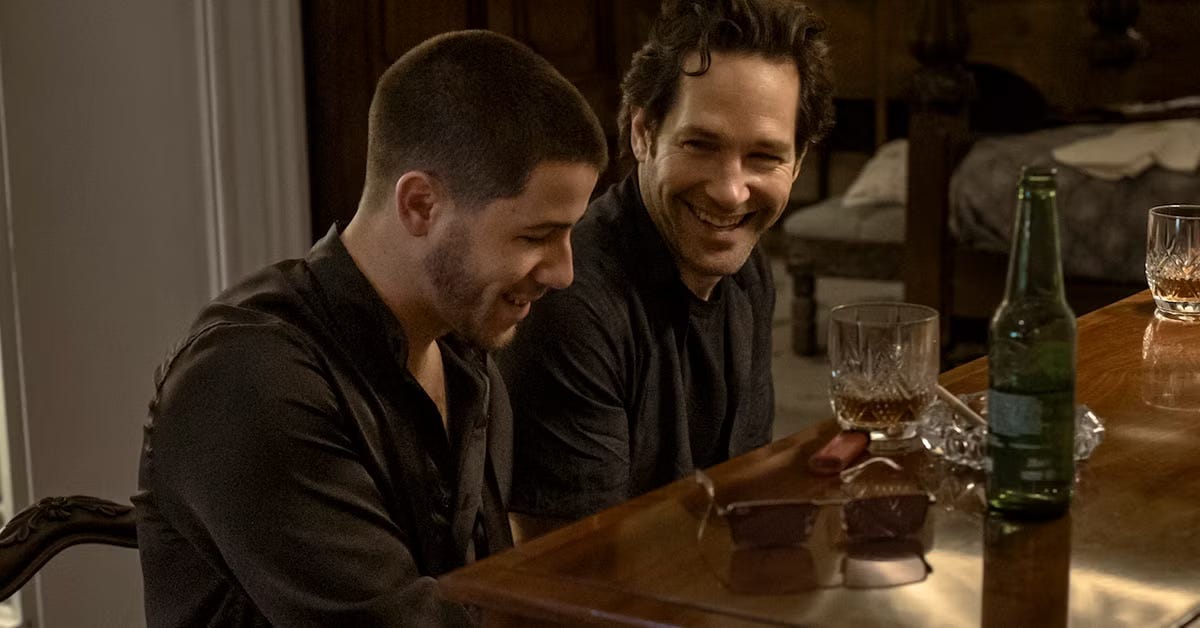
During one lavish gig, the bride and groom ask Rick if their friend can join him for a song. Their buddy is Danny Wilson (Nick Jonas), a former boy band member about to disappear into the “where are they now” files. Danny and Rick jam to Stevie Wonder’s “I Wish,” and create a nice viral moment. After the wedding, the two hang out, trading bridges and choruses over a late night of bourbon and weed. A few months later, Rick is shocked to hear the lyrics to one of his most personal songs playing over a mall’s muzak system. Danny’s created a runaway hit, and when Rick doesn’t get credit, he spirals.
The fun premise provides Carney with what is likely his biggest chance for a mainstream hit, particularly when anchored by a superstar like Rudd and former heartthrob Jonas. Rick cannot find any demos or written lyrics for his song, and Danny is so worried about being just another manufactured flavor of the month that he won’t admit the song might be more collaborative than he initially told his manager (Sing Street’s Jack Reynor). Feeling that his window out of obscurity is closing, Rick heads to L.A. with his bandmate Sandy (Peter McDonald) to get the credit he’s due.
Rudd’s charisma and energy are in full force in the scenes where Rick gets the crowds on their feet, and he has a surprisingly good voice. If the acting thing never works out, you could see him doing this for a living. The joke about the actor, of course, has long been his perpetual youth. But the years are starting to catch up. The lines burrow a bit deeper in his face and Rick carries a weariness from days of traveling with his band.
Rudd captures the frustration that gnaws at Rick, who quit touring with his band when his wife got pregnant. While he’s content, his constant noodling with songs suggests he’s still hoping for that breakthrough. He keeps it largely buried, but seeing Danny’s song reach a global audience without him drives him nuts. His dreams of relevance are ready to be snatched away, leaving him in obscurity while Danny fills arenas.
But Carney’s smart enough not to make Danny a villain. He had the fame Rick dreams of, but without the band, it’s fading away. His manager tells it straight: without a hit, he has no album. Without an album, he’s just a beat away from signing autographs at comic con and eating bugs on reality TV. When he plays Rick’s song for a love interest, he sees how strongly it connects. While he isn’t the one who wrote the lyrics, he is the one who figures out a way to do what Rick couldn’t – get the song in front of an audience.
Carney’s films frequently come dressed in formulaic packages – romances, coming of age stories, mother-son dramas – that allow him space in which to unpack the power of music to heal and unite people. No other director is so good at capturing the magic of artistic collaboration, from the unforgettable first performance of “Falling Slowly” in Once to the music videos that propel Sing Street’s young musicians. He understands the joy of live performance and the energy with which artists feed off each other. Power Ballad’s best scene is the late-night jam session between Rick and Danny, in which Rudd and Jonas noodle around on guitars, try out lyrics and help the other recover the joy of creation. The film’s central conflict is not that the collaboration tears them apart but that they need to eventually understand that the work is a collaboration, that there are mysteries involved in making music together. Who writes a song and who brings it to life? If a song can mean different things to different people, does the one who gets the biggest audience have more say over what that meaning is? Can there be as much power in singing to a hotel dance floor as there is in singing to an arena of thousands?
These are common Carney themes, but they never get old. He constantly finds a new angle through which to filter these obsessions, and each of his films explores new relationship dynamics and the way in which making art affects them. The director’s love of the form – and the fact that few people capture the sound and vibe of jam sessions and live music on screen better – keeps them powering through any cliches or rough spots. Also, Carney practices what he preaches; the film’s central number, “How to Write a Song,” is a genuine earworm.
Power Ballad struggles with balancing its deeper questions and some of their darker implications with the sitcom plot that occasionally erupts. It’s a lot of fun to watch Rick and Sandy crash a post-concert party in their quest to finally confront Danny; but it sits awkwardly after a scene in which Rick’s distraction nearly puts his family at risk and a raw moment in which he unloads his frustrations on his wife. Rudd’s really funny when Rick finally gets a chance to talk with Danny and doesn’t really know what to say, and while I like the conclusion he reaches, the resolution feels a bit too tidy for the thorniness that preceded it. Power Ballad is light and will please crowds, but hints of a more introspective movie occasionally peek out that I wish Carney had explored a bit more fully.
And yet, the film ties everything together with its final performance – a duet of sorts that takes place across continents, bringing all of the movie’s threads and themes together in a moment that brought tears to my eyes even as I realized I was being manipulated (although I wish Carney realized he didn’t need Rudd to explain the film’s theme verbally; the point’s made just as well without words). Maybe I’m just a sucker for this stuff. Or maybe it’s okay for a movie just to be a really catchy, enjoyable pop ballad; not everything needs to be a howl from the soul.
Power Ballad lacks the hungriness and passion that made Once such a gem, and it never quite hits the highs of Sing Street. But it’s funny and charming, and Carney still has new ideas to explore about the messiness and mystery of making music with others. I’ll keep showing up if he keeps writing the songs.